
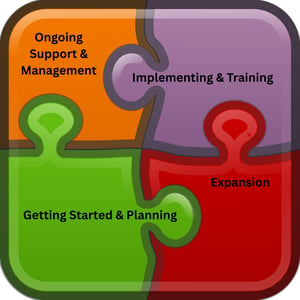
Most organizations don't lack data governance activity — they lack structure around it. Long before any formal program launches, informal governance is already happening everywhere: someone answers data definition questions over email, another team keeps its own glossary, someone else fields report requests as they come in. What a formal program adds isn't governance itself; it's coordination, consistency, and oversight. In an IData webinar, Brian Parish breaks the practical work of running a data governance program into four connected phases: Getting Started and Planning, Implementing and Training, Ongoing Support and Management, and Expansion. The first phase happens once; the other three tend to repeat every time your program takes on new content or a new part of the organization. Understanding all four helps an oversight team pace the work realistically instead of trying to do everything at once.
Here's what each phase involves, and how to know when you're ready to move to the next.
Phase 1: Getting Started and Planning
Before anything is implemented, the oversight team needs a plan the organization can rally behind. This phase centers on four tasks:
-
Set your roadmap and priorities. Decide what content you'll govern first, what organizational scope you're covering, which data systems and tools are in play, and which stakeholders need to be involved — driven by your organization's actual goals, not a generic checklist.
-
Secure leadership buy-in. A roadmap only works if leadership commits to it. Build something pragmatic and feasible, then frame the value in terms of outcomes — trust in data, consistency of definitions — rather than raw activity counts. “We wrote 1,000 business policy definitions” is a vanity metric; “the glossary gave departments a shared, trusted definition of enrollment” is the actual value.
-
Design the governance framework. Decide what gets documented, in what sequence, and how workflows route different types of requests. This becomes the operating model for everything that follows.
-
Recruit and assign data stewards. Match people to roles that fit their strengths — don't put a technical specialist in a purely functional steward role, or vice versa. Train stewards before assigning them and expect to distribute onboarding iteratively as new content areas come online rather than all at once.
Phase 2: Implementing and Training
With a plan and initial buy-in in place, the next phase is rolling the program out — one that, in practice, repeats every time you add new content or bring on a new group.
Seed the content before you ask people to contribute. If you ask stewards to write business definitions into an empty glossary, they have nothing to model their work on. Define your attributes and coding standards first — security classifications, functional areas, the drop-down choices people will use — then import or curate an initial batch of high-priority content. The goal is what Brian calls a “content tipping point”: enough good examples that new contributors feel like they're building on something, not starting from a blank page. Where you can automate this — pulling in a data model or a report list, ideally with ongoing synchronization rather than a one-time import — do it.
Train data stewards and participants — starting with why. Lead with the goals and the reasoning behind the program before walking through tools and processes; people who understand why the work matters are more likely to participate. From there, support data stewards through the review and approval process, train the broader community on how to submit requests or new content, and set — and communicate — clear standards, such as a three-day turnaround on new report documentation requests, so everyone knows what to expect and you can measure against it.
Give constructive, structured feedback. As new stewards start writing definitions, building report specs, or assigning policy attributes, give them a way to request an oversight review and get feedback. Keep the oversight group intentionally small - often four to six committed champions rather than a large committee — so feedback stays fast and consistent.
Train data stewards to pull in collaborators. You won't have a dedicated steward for every content area on day one. Teach stewards that it's normal to loop in a subject-matter expert when they hit something outside their coverage, or to ask the oversight group for support.
Have the oversight group act as stewards where roles are still vacant. Early on, you'll have gaps in the stewardship workflow. Assigning oversight members to those workflows — directly, or through dedicated placeholder steward roles — keeps requests from falling through the cracks and often becomes the on-ramp for recruiting the eventual permanent steward.
Phase 3: Ongoing Support and Management
Once stewards are trained and processes are running, the role shifts from building to sustaining. This is where oversight and management become a continuous discipline rather than a project with an end date:
- Monitor requests and activity like a support desk. Track response times the way you would with a ticketing system. Timely responses build buy-in on both sides — from the people making requests and from the stewards doing the work. Slow responses erode it just as fast.
- Support stewards who are stuck. Provide ongoing mentoring, make sure stewards have enough time allocated to do the work, and be willing to step in and move something along yourself when the content needs to take priority.
- Resolve collisions constructively. Disagreements between data stewards, offices, or teams over a definition, a policy attribute, or ownership will happen — and when they do, treat it as a sign the process is working. These disagreements existed before governance; they just weren't visible. In many cases, different definitions can coexist if the context for each is documented; where they can't, the oversight group's role is to help facilitate a resolution.
- Champion the program. Momentum fades naturally as people return to their day-to-day priorities. Keep governance visible with lunch-and-learns, webinars, internal outreach, and by training new trainers as the program grows.
- Measure, report, and reward. Track and share progress against your high-level goals — both up to leadership and back to the people doing the work. Simple incentives, such as recognizing the first department to reach a milestone, and internal resources like a governance webpage help sustain participation.
- Don't overlook the administrative load. Scheduling, agendas, meeting notes, regular one-on-ones with stewards (especially new ones), and day-to-day tool administration — user management, technical support, configuration — all need an owner, whether that's you or someone you bring in to help.
Phase 4: Expansion
Once a program is working well in one area, the natural next step is to expand it — either to new types of content (moving from a glossary and report catalog to reference data and quality monitoring, for example) or to new parts of the organization (from HR to finance, or from the data warehouse to transactional systems).
Expansion means recruiting a new layer of stakeholders and reapplying much of the implementation and training work to each new area. It's also one of the most common places where programs get stuck: it's easy to succeed with an initial group and never move past it. The way to avoid that is to plan for expansion from the start — treat “land and expand” as the strategy rather than something to figure out later.
Bringing It All Together
These four phases aren't strictly sequential. Implementing and Training, Ongoing Support and Management, and Expansion tend to repeat in a cycle as your program matures and grows into new areas. That can feel like a lot, especially early on. If your organization doesn't yet have a full governance culture, doesn't have dedicated time for it, or feels like it's not ready, that's a normal starting point, not a disqualifier.
The point of laying out all four phases isn't that you need to do everything at once — it's so you know what “done well” ultimately looks like and can prioritize the pieces that serve your organization's goals right now while growing into the rest.
Hope this blog post was of assistance to you and your organization. All our data governance and data intelligence resources (blog posts, videos, and recorded webinars) can be accessed from our data governance resources page. IData has a solution, the Data Cookbook, that can aid the employees and the organization in its data governance, data intelligence, data stewardship and data quality initiatives. IData also has experts that can assist with data governance, reporting, integration and other technology services on an as needed basis. Feel free to contact us and let us know how we can assist.

Image Credit: BlogPost_PhasesofDGOversightManagement_BP #B1334
