
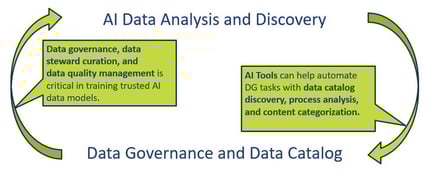
 After reviewing our recent blog posts, I realized that Aaron Walker has written several (6 in fact) around the topic of artificial intelligence (AI). And I want in on the conversation. In my opinion, for AI success at your organization you need to have data governance success. AI governance is a part of data governance. This blog post will cover how data governance can help with your AI efforts along with some additional thoughts.
Without data governance in place, AI systems may produce unreliable results, thus increasing risk and confusion. Data governance builds trust in data which is necessary for AI. Don't treat AI governance as a separate silo. It needs to be integrated with data governance. If separate then there is duplicated effort, conflicting policies, increased risks, and unnecessary cost due to inefficiencies.
Here is how data governance can help AI:
1. Train AI models using trusted and certified query examples and technical definitions
You want to continuously train your AI with curated content from the report catalog located in your data governance solution. You do this by the following:
- Seed with initial certified report catalog examples
- Continue to add new human-created certified report catalog examples
- Continue to train with validated AI generated content by eliminating or fixing incorrect generated AI content
Check out our report catalog, specifications, and data processing catalog resources blog post.
2. Provide business glossary definitions as guardrails for AI prompts
You do this by training AI with business glossary functional and technical definitions located in your data governance solution.
Check out our business glossary spotlight for additional resources.
3. Ensure your data sources have high data quality
Data governance provides the high data quality that is needed by AI. For data quality you will need quality monitoring, quality assessments, quality rules and a process to resolve quality issues when they are reported. All of which is contained in your data governance solution.
Check out our data quality spotlight for additional resources.
4. Create a well-understood and automated path for curating and approving AI generated content
Document your process in your data governance solution.
Just like everyone else who is involved in or interested in implementing AI at an organization I have been reading a great deal of articles on the subject. AI is not only for larger organizations, but works just as well for organizations of all sizes and types, especially those that have good data literacy, knowledgeable staff, and a good handle on their data governance. I enjoyed reading an article titled "Treasury's Data Reset: How Governance, AI, and Literacy Are Powering Smarter Policy" that was on Fed Gov Today. In the article, there is an interview with the Acting Chief Data Officer for the US Treasury Department, David Ashley, talking about the Treasury's push for data governance over the last few years. Ashley describes an ongoing effort to build a comprehensive data catalog that identifies Treasury's data assets and where they are stored. Ashley emphasizes that data quality is paramount. Without reliable data, analysis loses its value.
Feel free to check out Aaron's blog posts related to AI:
- Intelligence Governance for AI
- Data Foundations for AI - Enhanced Analytics
- More Thoughts on Analytics, AI, and Data Quality
- Demystifying Analytics and AI
- Your Data is Not Yet Ready for AI. Is Your Data Governance?
- (How) Can AI Help Data Stewards
Here are some other thoughts regarding AI and data governance:
-
Implementing AI into an organization is not just a technology project. It affects the data that is depended on and touches those that interact with our organization.
-
Many organizations have siloed databases, legacy applications, and informal workflows melded together to work. But this will not work for AI and thus the need for data governance to remove the silos, document the applications, and have formal workflows. You don't want different AI tools providing different answers to the same questions.
-
Start small with AI. Have a limited specific purpose and set the appropriate expectations (for the organization and the users of AI). Make sure that the AI users have the proper guidance.
-
When a person is asked "How many employees did you have this year?", they know to ask a follow-up clarification question such as calendar year or fiscal year. AI usually does not know to ask this follow-up question and, even worse, might randomly pick an answer. Also the same question to different groups might get a different answer (and probably rightfully so) due to knowledge of the answerer. For AI, there needs to be more information in the question to get the correct answer.
-
You only want AI to interact with curated data (not raw transactional tables), that has been reviewed by a human. You do not want to give AI unrestricted access to your data. AI access needs to be governed and access should be only to trusted data.
-
Realize that AI can not answer every question it is asked. Make sure that the AI tool admits when it doesn't know and asks for additional information that can be reviewed later by a human to fine tune AI for the future. There is a cycle of fine tune, monitor, and retrain. This is how the AI gets better as accuracy and trust are improved.
-
People are still necessary with AI. You want AI to handle the repetitive and easy to define tasks. People in your organization can focus on curating and improving data as well as fine tuning the AI.
- Make a list of often asked and high impact questions and then analyze where the answers are located. Data governance should provide you with the locations for the answers.
- Obvious, much like a new software release, make sure that you do a great deal of testing of the AI before releasing it to those outside of your organization such as vendors, prospects, student, donors, etc.
- Leadership at the organization needs to covey a vision of what AI can do for the organization.
- AI will expose missing or incorrect content in data governance (such as a missing definition or a poor definition). Be ready to make the necessary content changes as these exposures happen.
- And lastly you need to have a great data intelligence partner like IData Inc. and a data governance and data intelligence solution in place like the Data Cookbook. A solution will allow all the data-related information (content) to be in one place and provide a framework necessary for success.
If you would like to watch our hour long recorded webinar titled "The AI Data Curation Cycle: Applying AI to Data Governance and Data Governance to AI" then click here.
Hope this blog post and the mentioned resources were of assistance to you. All our data governance and data intelligence resources (blog posts, videos, and recorded webinars) can be accessed from our data governance resources page.
IData has a solution, the Data Cookbook, that can aid the employees and the organization in its data governance, data intelligence, data stewardship and data quality initiatives. IData also has experts that can assist with data governance, reporting, integration and other technology services on an as needed basis. Feel free to contact us and let us know how we can assist.

Image Credit: AIandDGCycle Image from Webinar #B1307
